Note
Go to the end to download the full example code
PyTorch Backend Example: Multi-Graph Matching
This example shows how to match multiple graphs. Multi-graph matching means that more than two graphs are jointly matched.
# Author: Zetian Jiang <maple_jzt@sjtu.edu.cn>
#         Ziao Guo <ziao.guo@sjtu.edu.cn>
#
# License: Mulan PSL v2 License
Note
The following solvers are included in this example:
rrwm()(classic solver)cao()(classic solver)mgm_floyd()(classic solver)
import os
import time
import math
import copy
import torch  # pytorch backend
import itertools
import numpy as np
import pygmtools as pygm
import matplotlib.pyplot as plt  # for plotting
import scipy.io as sio  # for loading .mat file
import scipy.spatial as spa  # for Delaunay triangulation

from PIL import Image
from matplotlib.patches import ConnectionPatch # for plotting matching result

pygm.set_backend('pytorch')  # set default backend for pygmtools
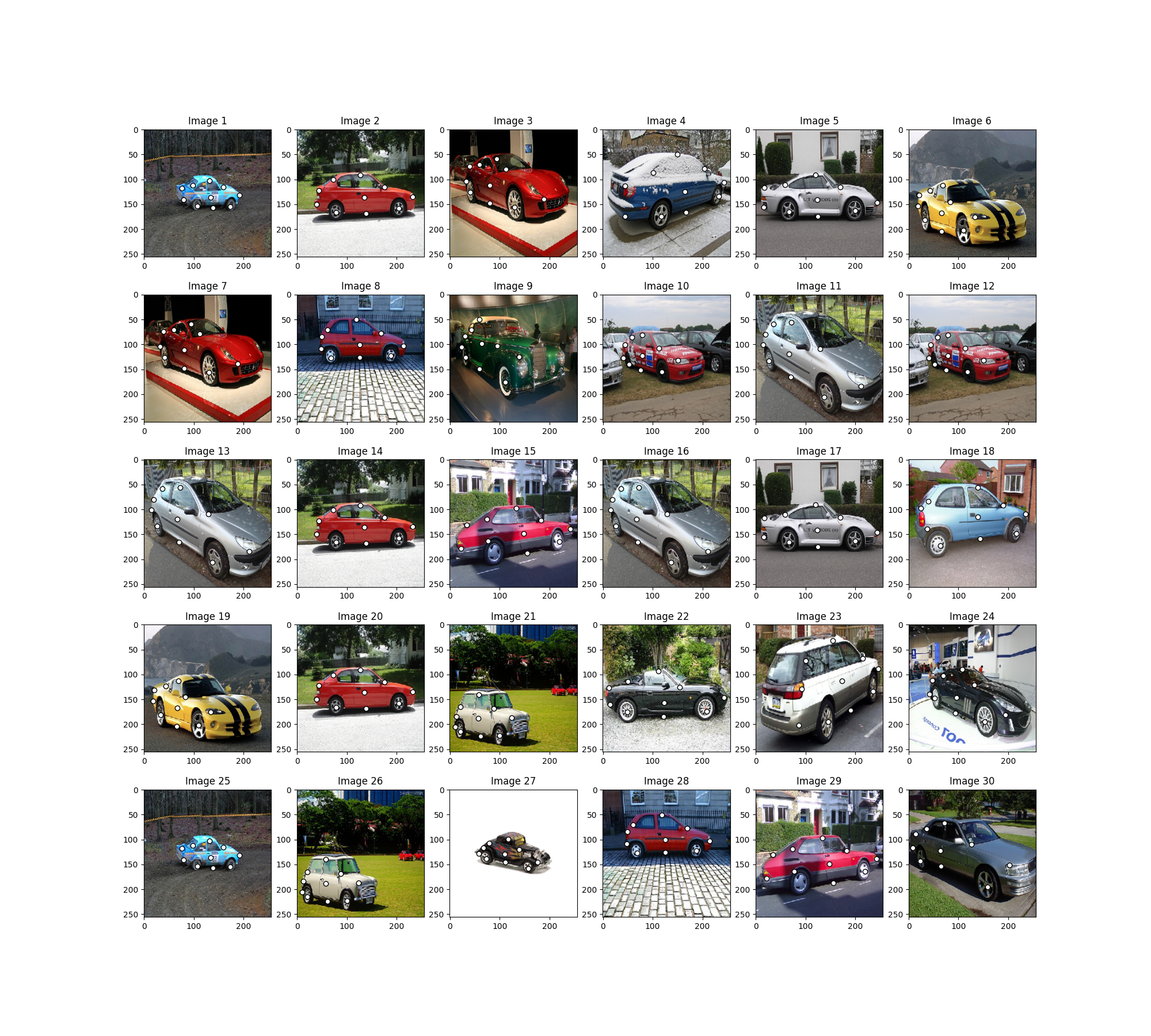
Load the images
Images are from the Willow Object Class dataset (this dataset also available with the Benchmark of pygmtools,
see WillowObject).
The images are resized to 256x256.
obj_resize = (256, 256)
n_images = 30
n_outlier = 0
img_list = []
kpts_list = []
n_kpts_list = []
perm_list = []

bm = pygm.benchmark.Benchmark(name='WillowObject',
                              sets='train',
                              obj_resize=obj_resize)

while len(img_list) < n_images:
    data_list, gt_dict, _ = bm.rand_get_data(cls='Car')
    for data in data_list:
        img = Image.fromarray(data['img'])
        coords = sorted(data['kpts'], key=lambda x: x['labels'])
        kpts = torch.tensor([[kpt['x'] for kpt in coords],
                        [kpt['y'] for kpt in coords]])
        perm = np.eye(kpts.shape[1])
        img_list.append(img)
        kpts_list.append(kpts)
        n_kpts_list.append(kpts.shape[1])
        perm_list.append(perm)
Visualize the images and keypoints
def plot_image_with_graph(img, kpt, A=None):
    plt.imshow(img)
    plt.scatter(kpt[0], kpt[1], c='w', edgecolors='k')
    if A is not None:
        for idx in torch.nonzero(A, as_tuple=False):
            plt.plot((kpt[0, idx[0]], kpt[0, idx[1]]), (kpt[1, idx[0]], kpt[1, idx[1]]), 'k-')


plt.figure(figsize=(20, 18))
for i in range(n_images):
    plt.subplot(5, n_images // 5, i + 1)
    plt.title('Image {}'.format(i + 1))
    plot_image_with_graph(img_list[i], kpts_list[i])
# plt.savefig('image')
# plt.close()
Build the graphs
Graph structures are built based on the geometric structure of the keypoint set. In this example, we refer to Delaunay triangulation.
def delaunay_triangulation(kpt):
    d = spa.Delaunay(kpt.numpy().transpose())
    A = torch.zeros(len(kpt[0]), len(kpt[0]))
    for simplex in d.simplices:
        for pair in itertools.permutations(simplex, 2):
            A[pair] = 1
    return A


adj_list = []
for i in range(n_images):
    A = delaunay_triangulation(kpts_list[i])
    adj_list.append(A)
Build affinity matrix
We follow the formulation of Quadratic Assignment Problem (QAP):
where the first step is to build the affinity matrix (\(\mathbf{K}\)) for each pair of graphs
def get_feature(n, points, adj):
    """
    :param n: points # of graph
    :param points: torch tensor, (n, 2)
    :param adj: torch tensor, (n, n)
    :return: edge feat, angle feat
    """
    points_1 = points.reshape(n, 1, 2).repeat(1, n, 1)
    points_2 = points.reshape(1, n, 2).repeat(n, 1, 1)
    edge_feat = torch.sqrt(torch.sum((points_1 - points_2) ** 2, dim=2))
    edge_feat = edge_feat / torch.max(edge_feat)
    angle_feat = torch.atan((points_1[:, :, 1] - points_2[:, :, 1]) / (points_1[:, :, 0] - points_2[:, :, 0] + 1e-8))
    angle_feat = 2 * angle_feat / math.pi

    return edge_feat, angle_feat


def get_pair_affinity(edge_feat_1, angle_feat_1, edge_feat_2, angle_feat_2, adj1, adj2):
    n1, n2 = edge_feat_1.shape[0], edge_feat_2.shape[0]
    assert n1 == angle_feat_1.shape[0] and n2 == angle_feat_2.shape[0]

    left_adj = adj1.reshape(n1, n1, 1, 1).repeat(1, 1, n2, n2)
    right_adj = adj2.reshape(1, 1, n2, n2).repeat(n1, n1, 1, 1)
    adj = left_adj * right_adj

    left_edge_feat = edge_feat_1.reshape(n1, n1, 1, 1, -1).repeat(1, 1, n2, n2, 1)
    right_edge_feat = edge_feat_2.reshape(1, 1, n2, n2, -1).repeat(n1, n1, 1, 1, 1)
    edge_weight = torch.sqrt(torch.sum((left_edge_feat - right_edge_feat) ** 2, dim=-1))

    left_angle_feat = angle_feat_1.reshape(n1, n1, 1, 1, -1).repeat(1, 1, n2, n2, 1)
    right_angle_feat = angle_feat_2.reshape(1, 1, n2, n2, -1).repeat(n1, n1, 1, 1, 1)
    angle_weight = torch.sqrt(torch.sum((left_angle_feat - right_angle_feat) ** 2, dim=-1))

    affinity = edge_weight * 0.9 + angle_weight * 0.1
    affinity = torch.exp(-affinity / 0.1) * adj
    affinity = affinity.transpose(1, 2)

    return affinity


def generate_affinity_matrix(n_points, points_list, adj_list):
    m = len(n_points)
    n_max = max(n_points)
    affinity = torch.zeros(m, m, n_max, n_max, n_max, n_max)

    edge_feat_list = []
    angle_feat_list = []
    for n, points, adj in zip(n_points, points_list, adj_list):
        edge_feat, angle_feat = get_feature(n, points, adj)
        edge_feat_list.append(edge_feat)
        angle_feat_list.append(angle_feat)

    for i, j in itertools.product(range(m), range(m)):
        pair_affinity = get_pair_affinity(edge_feat_list[i],
                                          angle_feat_list[i],
                                          edge_feat_list[j],
                                          angle_feat_list[j],
                                          adj_list[i],
                                          adj_list[j])
        affinity[i, j] = pair_affinity

    affinity = affinity.permute(0, 1, 3, 2, 5, 4).reshape(m, m, n_max * n_max, n_max * n_max)
    return affinity


affinity_mat = generate_affinity_matrix(n_kpts_list, kpts_list, adj_list)

m = len(kpts_list)
n = int(torch.max(torch.tensor(n_kpts_list)))
ns_src = torch.ones(m * m).int() * n
ns_tgt = torch.ones(m * m).int() * n
Calculate accuracy, consistency, and affinity
def cal_accuracy(mat, gt_mat, n):
    m = mat.shape[0]
    acc = 0
    for i in range(m):
        for j in range(m):
            _mat, _gt_mat = mat[i, j], gt_mat[i, j]
            row_sum = torch.sum(_gt_mat, dim=0)
            col_sum = torch.sum(_gt_mat, dim=1)
            row_idx = [k for k in range(n) if row_sum[k] != 0]
            col_idx = [k for k in range(n) if col_sum[k] != 0]
            _mat = _mat[row_idx, :]
            _mat = _mat[:, col_idx]
            _gt_mat = _gt_mat[row_idx, :]
            _gt_mat = _gt_mat[:, col_idx]
            acc += 1 - torch.sum(torch.abs(_mat - _gt_mat)) / 2 / (n - n_outlier)
    return acc / (m * m)


def cal_consistency(mat, gt_mat, m, n):
    return torch.mean(get_batch_pc_opt(mat))


def cal_affinity(X, X_gt, K, m, n):
    X_batch = X.reshape(-1, n, n)
    X_gt_batch = X_gt.reshape(-1, n, n)
    K_batch = K.reshape(-1, n * n, n * n)
    affinity = get_batch_affinity(X_batch, K_batch)
    affinity_gt = get_batch_affinity(X_gt_batch, K_batch)
    return torch.mean(affinity / (affinity_gt + 1e-8))


def get_batch_affinity(X, K, norm=1):
    """
    calculate affinity score
    :param X: (b, n, n)
    :param K: (b, n*n, n*n)
    :param norm: normalization term
    :return: affinity_score (b, 1, 1)
    """
    b, n, _ = X.size()
    vx = X.transpose(1, 2).reshape(b, -1, 1)  # (b, n*n, 1)
    vxt = vx.transpose(1, 2)  # (b, 1, n*n)
    affinity = torch.bmm(torch.bmm(vxt, K), vx) / norm
    return affinity


def get_single_affinity(X, K, norm=1):
    """
    calculate affinity score
    :param X: (n, n)
    :param K: (n*n, n*n)
    :param norm: normalization term
    :return: affinity_score scale
    """
    n, _ = X.size()
    vx = X.transpose(0, 1).reshape(-1, 1)
    vxt = vx.transpose(0, 1)
    affinity = torch.matmul(torch.matmul(vxt, K), vx) / norm
    return affinity


def get_single_pc(X, i, j, Xij=None):
    """
    :param X: (m, m, n, n) all the matching results
    :param i: index
    :param j: index
    :param Xij: (n, n) matching
    :return: the consistency of X_ij
    """
    m, _, n, _ = X.size()
    if Xij is None:
        Xij = X[i, j]
    pair_con = 0
    for k in range(m):
        X_combo = torch.matmul(X[i, k], X[k, j])
        pair_con += torch.sum(torch.abs(Xij - X_combo)) / (2 * n)
    return 1 - pair_con / m


def get_single_pc_opt(X, i, j, Xij=None):
    """
    :param X: (m, m, n, n) all the matching results
    :param i: index
    :param j: index
    :return: the consistency of X_ij
    """
    m, _, n, _ = X.size()
    if Xij is None:
        Xij = X[i, j]
    X1 = X[i, :].reshape(-1, n, n)
    X2 = X[:, j].reshape(-1, n, n)
    X_combo = torch.bmm(X1, X2)
    pair_con = 1 - torch.sum(torch.abs(Xij - X_combo)) / (2 * n * m)
    return pair_con


def get_batch_pc(X):
    """
    :param X: (m, m, n, n) all the matching results
    :return: (m, m) the consistency of X
    """
    pair_con = torch.zeros(m, m).cuda()
    for i in range(m):
        for j in range(m):
            pair_con[i, j] = get_single_pc_opt(X, i, j)
    return pair_con


def get_batch_pc_opt(X):
    """
    :param X: (m, m, n, n) all the matching results
    :return: (m, m) the consistency of X
    """
    m, _, n, _ = X.size()
    X1 = X.reshape(m, 1, m, n, n).repeat(1, m, 1, 1, 1).reshape(-1, n, n)  # X1[i, j, k] = X[i, k]
    X2 = X.reshape(1, m, m, n, n).repeat(m, 1, 1, 1, 1).transpose(1, 2).reshape(-1, n, n)  # X2[i, j, k] = X[k, j]
    X_combo = torch.bmm(X1, X2).reshape(m, m, m, n, n)
    X_ori = X.reshape(m, m, 1, n, n).repeat(1, 1, m, 1, 1)
    pair_con = 1 - torch.sum(torch.abs(X_combo - X_ori), dim=(2, 3, 4)) / (2 * n * m)
    return pair_con


def eval(mat, gt_mat, affinity, m, n):
    acc = cal_accuracy(mat, gt_mat, n)
    src = cal_affinity(mat, gt_mat, affinity, m, n)
    con = cal_consistency(mat, gt_mat, m, n)
    return acc, src, con
Generate gt mat
gt_mat = torch.zeros(m, m, n, n)
for i in range(m):
    for j in range(m):
        gt_mat[i, j] = torch.tensor(np.matmul(perm_list[i].transpose(0, 1), perm_list[j]))
# print(perm_list[0])
# print(perm_list[1])
# print(gt_mat[1, 2])
# print(gt_mat[0, 1] - gt_mat[1, 0].transpose(0, 1))
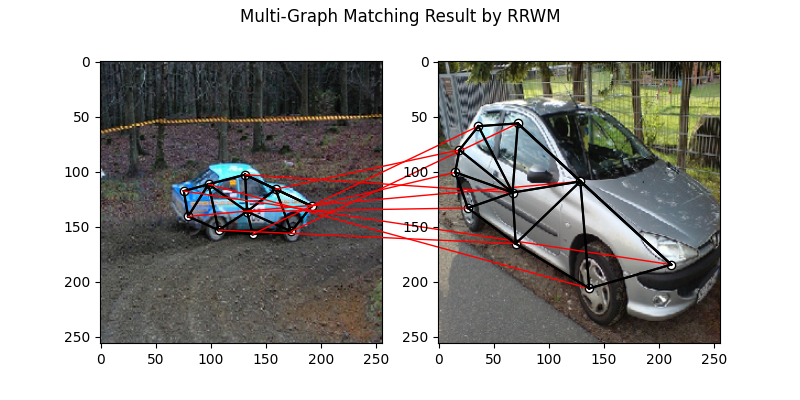
Pairwise graph matching by RRWM
See rrwm() for the API reference.
a = 0
b = 12
tic = time.time()
rrwm_mat = pygm.classic_solvers.rrwm(affinity_mat.reshape(-1, n * n, n * n), ns_src, ns_tgt)
rrwm_mat = pygm.linear_solvers.hungarian(rrwm_mat)
toc = time.time()
rrwm_mat = rrwm_mat.reshape(m, m, n, n)
rrwm_acc, rrwm_src, rrwm_con = eval(rrwm_mat, gt_mat, affinity_mat, m, n)
rrwm_tim = toc - tic

plt.figure(figsize=(8, 4))
plt.suptitle('Multi-Graph Matching Result by RRWM')
ax1 = plt.subplot(1, 2, 1)
plot_image_with_graph(img_list[a], kpts_list[a], adj_list[a])
ax2 = plt.subplot(1, 2, 2)
plot_image_with_graph(img_list[b], kpts_list[b], adj_list[b])
X = rrwm_mat[a, b]
for i in range(X.shape[0]):
    j = torch.argmax(X[i]).item()
    con = ConnectionPatch(xyA=kpts_list[a][:, i], xyB=kpts_list[b][:, j], coordsA="data", coordsB="data",
                          axesA=ax1, axesB=ax2, color="red" if i != j else "green")
    plt.gca().add_artist(con)
# plt.savefig("RRWM.png")
# plt.close()
Multi graph matching by multi-graph solvers
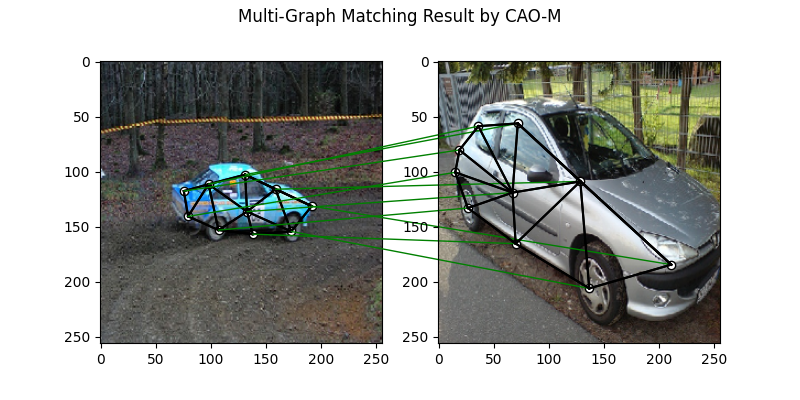
Multi graph matching: CAO-M See
cao()for the API reference.
base_mat = copy.deepcopy(rrwm_mat)
tic = time.time()
cao_m_mat = pygm.multi_graph_solvers.cao(affinity_mat, base_mat, mode='memory')
cao_m_mat = pygm.linear_solvers.hungarian(cao_m_mat.reshape(-1, n, n)).reshape(m, m, n, n)
toc = time.time()
cao_m_acc, cao_m_src, cao_m_con = eval(cao_m_mat, gt_mat, affinity_mat, m, n)
cao_m_tim = toc - tic + rrwm_tim

plt.figure(figsize=(8, 4))
plt.suptitle('Multi-Graph Matching Result by CAO-M')
ax1 = plt.subplot(1, 2, 1)
plot_image_with_graph(img_list[a], kpts_list[a], adj_list[a])
ax2 = plt.subplot(1, 2, 2)
plot_image_with_graph(img_list[b], kpts_list[b], adj_list[b])
X = cao_m_mat[a, b]
for i in range(X.shape[0]):
    j = torch.argmax(X[i]).item()
    con = ConnectionPatch(xyA=kpts_list[a][:, i], xyB=kpts_list[b][:, j], coordsA="data", coordsB="data",
                          axesA=ax1, axesB=ax2, color="red" if i != j else "green")
    plt.gca().add_artist(con)
# plt.savefig("CAO-M.png")
# plt.close()
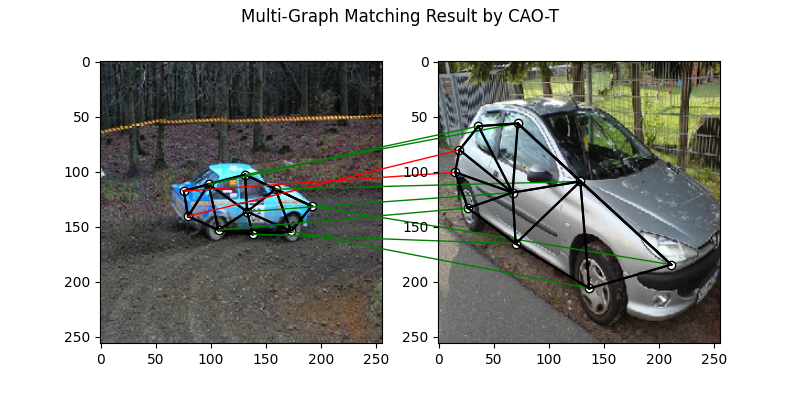
Multi graph matching: CAO-T
See cao() for the API reference.
base_mat = copy.deepcopy(rrwm_mat)
tic = time.time()
cao_t_mat = pygm.multi_graph_solvers.cao(affinity_mat, base_mat, mode='time')
cao_t_mat = pygm.linear_solvers.hungarian(cao_t_mat.reshape(-1, n, n)).reshape(m, m, n, n)
toc = time.time()
cao_t_acc, cao_t_src, cao_t_con = eval(cao_t_mat, gt_mat, affinity_mat, m, n)
cao_t_tim = toc - tic + rrwm_tim

plt.figure(figsize=(8, 4))
plt.suptitle('Multi-Graph Matching Result by CAO-T')
ax1 = plt.subplot(1, 2, 1)
plot_image_with_graph(img_list[a], kpts_list[a], adj_list[a])
ax2 = plt.subplot(1, 2, 2)
plot_image_with_graph(img_list[b], kpts_list[b], adj_list[b])
X = cao_t_mat[a, b]
for i in range(X.shape[0]):
    j = torch.argmax(X[i]).item()
    con = ConnectionPatch(xyA=kpts_list[a][:, i], xyB=kpts_list[b][:, j], coordsA="data", coordsB="data",
                          axesA=ax1, axesB=ax2, color="red" if i != j else "green")
    plt.gca().add_artist(con)
# plt.savefig("CAO-T.png")
# plt.close()
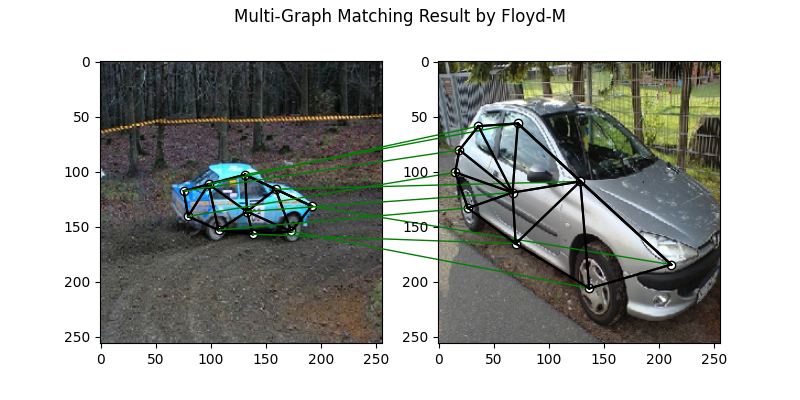
Multi graph matching: MGM-Floyd-M
See mgm_floyd() for the API reference.
base_mat = copy.deepcopy(rrwm_mat)
tic = time.time()
floyd_m_mat = pygm.multi_graph_solvers.mgm_floyd(affinity_mat, base_mat, param_lambda=0.4, mode='memory')
floyd_m_mat = pygm.linear_solvers.hungarian(floyd_m_mat.reshape(-1, n, n)).reshape(m, m, n, n)
toc = time.time()
floyd_m_acc, floyd_m_src, floyd_m_con = eval(floyd_m_mat, gt_mat, affinity_mat, m, n)
floyd_m_tim = toc - tic + rrwm_tim

plt.figure(figsize=(8, 4))
plt.suptitle('Multi-Graph Matching Result by Floyd-M')
ax1 = plt.subplot(1, 2, 1)
plot_image_with_graph(img_list[a], kpts_list[a], adj_list[a])
ax2 = plt.subplot(1, 2, 2)
plot_image_with_graph(img_list[b], kpts_list[b], adj_list[b])
X = floyd_m_mat[a, b]
for i in range(X.shape[0]):
    j = torch.argmax(X[i]).item()
    con = ConnectionPatch(xyA=kpts_list[a][:, i], xyB=kpts_list[b][:, j], coordsA="data", coordsB="data",
                          axesA=ax1, axesB=ax2, color="red" if i != j else "green")
    plt.gca().add_artist(con)
# plt.savefig("Floyd-M.png")
# plt.close()
Multi graph matching: MGM-Floyd-T
See mgm_floyd() for the API reference.
base_mat = copy.deepcopy(rrwm_mat)
tic = time.time()
floyd_t_mat = pygm.multi_graph_solvers.mgm_floyd(affinity_mat, base_mat, param_lambda=0.6, mode='time')
floyd_t_mat = pygm.linear_solvers.hungarian(floyd_t_mat.reshape(-1, n, n)).reshape(m, m, n, n)
toc = time.time()
floyd_t_acc, floyd_t_src, floyd_t_con = eval(floyd_t_mat, gt_mat, affinity_mat, m, n)
floyd_t_tim = toc - tic + rrwm_tim

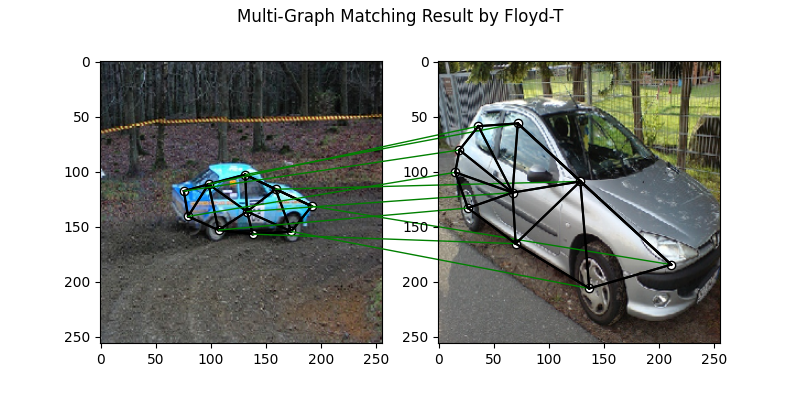
plt.figure(figsize=(8, 4))
plt.suptitle('Multi-Graph Matching Result by Floyd-T')
ax1 = plt.subplot(1, 2, 1)
plot_image_with_graph(img_list[a], kpts_list[a], adj_list[a])
ax2 = plt.subplot(1, 2, 2)
plot_image_with_graph(img_list[b], kpts_list[b], adj_list[b])
X = floyd_t_mat[a, b]
for i in range(X.shape[0]):
    j = torch.argmax(X[i]).item()
    con = ConnectionPatch(xyA=kpts_list[a][:, i], xyB=kpts_list[b][:, j], coordsA="data", coordsB="data",
                          axesA=ax1, axesB=ax2, color="red" if i != j else "green")
    plt.gca().add_artist(con)
# plt.savefig("Floyd-T.png")
# plt.close()
Total running time of the script: (0 minutes 22.959 seconds)